Projects · research · professional collaboration
Research and development that leads to practical results.
Academic research, applied development and authored software projects. I connect expertise in information systems, cybersecurity and usability with practical user needs.
- Areas of expertise
- Security · information systems · HCI
- Forms of collaboration
- Research · consulting · evaluation · lectures
- Potential partners
- Universities · organisations · public administration
FROM KNOWLEDGE TO APPLICATIONS
Own software projects
Alongside academic research, I design and develop my own software solutions. I connect usability, cybersecurity and information systems with practical user needs.

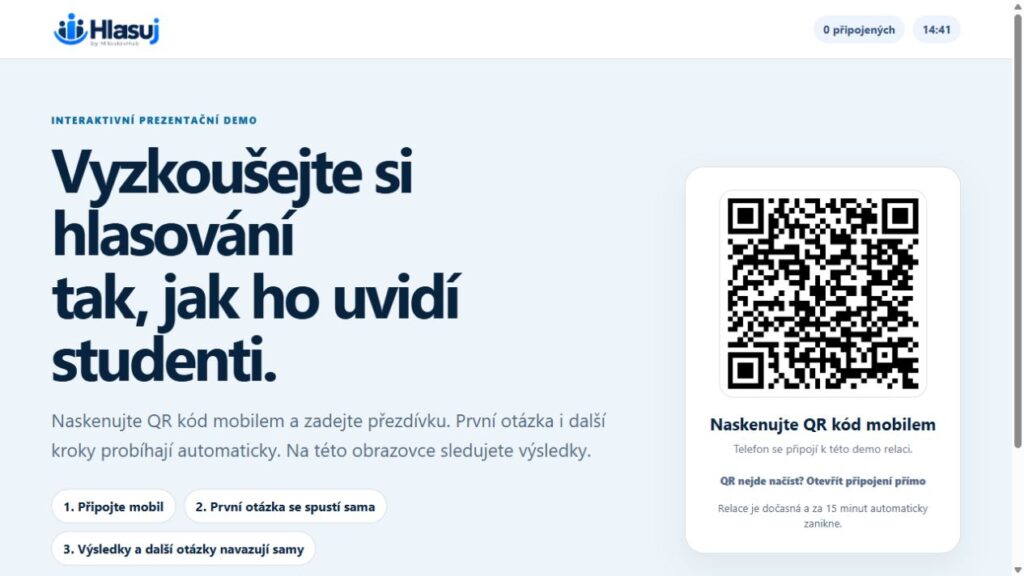
Hlasuj!
Public demo · continuing development
Quizzes, polls and interactive questions for teaching, training and presentations. Participants join from their phones through a QR code.

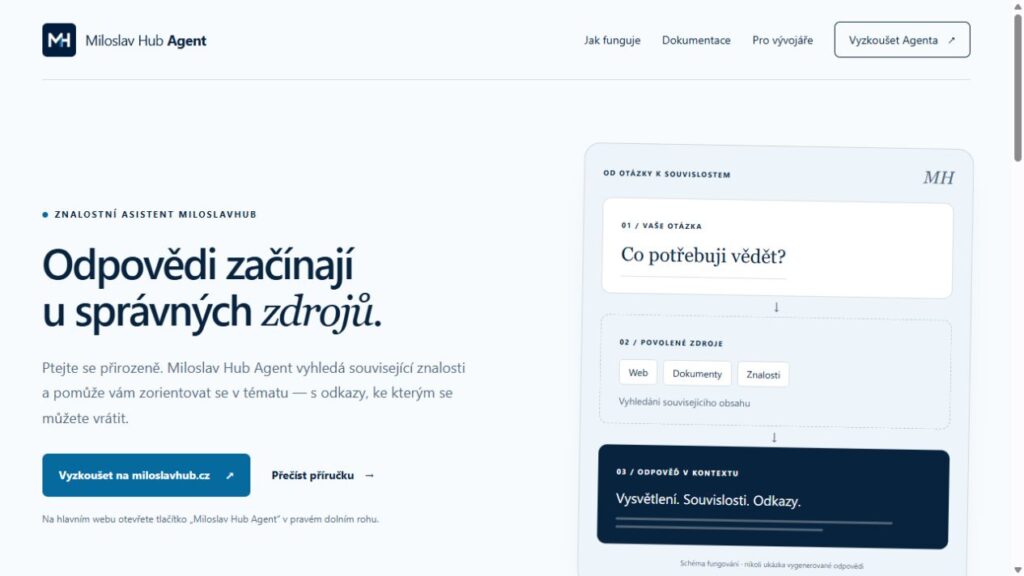
Miloslav Hub Agent
Public test interface · in development
An AI assistant for finding and explaining information from available knowledge sources. The public interface is available for testing.
The cards distinguish a public demo from a project in development. Details and links to the public interfaces follow below.
Hlasuj! — audience participation
A lecture or workshop benefits from feedback while there is still time to respond. Hlasuj! gives participants a simple way to answer questions and see results.
Who it is for
Teachers, university lecturers, trainers and organisations running learning activities or presentations.
Available in the public presentation and demo
- Join through a QR code in a browser, without installing an app.
- Quizzes with correct answers and polls collecting opinions.
- Results for participants and a presentation screen.
Status: a public product website and temporary interactive demo are available. The project continues to evolve. Its connection to my expertise lies in usable interaction, feedback and information system design.
Product website · Public documentation · LinkedIn — Hlasuj! · Facebook — Hlasuj!
Miloslav Hub Agent — working with knowledge
The Agent is intended to help visitors navigate information and available knowledge sources through natural-language questions.
What is publicly available
- A public project introduction and user guide.
- A chat interface on this website for questions about publications, research, teaching and professional activities.
Status: development / public test. The wider system remains partially completed. Availability of the interface does not establish the quality of every answer. Check important information against its sources; AI can make mistakes.
The project connects information retrieval, knowledge systems and human interaction with AI. The public presentation focuses on use and limitations.
On the main website, use the “Miloslav Hub Agent” button in the lower right corner.
MiloslavHub platform
Connected project infrastructure · continuing development
MiloslavHub is the wider environment in which I connect my applications and related services. It provides practical experience in information system design and integration. Individual parts have different levels of maturity; publicly available functionality is described with each project.
Authored projects are presented separately from university roles. Hlasuj! and the Agent are not official University of Pardubice systems; their presentation does not imply university endorsement.
Collaboration principle
From a well-defined problem to a defensible conclusion
A good project does not begin with a method or technology. It begins with a question worth answering.
The first step is to clarify the problem, the expected output and the criteria by which its value can be assessed. Only then can an appropriate research, analytical or evaluation method be chosen.
I bring experience in empirical research, information systems evaluation and connecting technical and human perspectives. My work emphasises transparent use of data and clear acknowledgement of limitations.
An output should be methodologically defensible and understandable to the people who will use it for decision-making. Interpretation and realistic recommendations are therefore part of the work.
Areas of expertise
Areas suited to a joint project
Collaboration offers the greatest value where technology meets user behaviour, organisational practice and the need for responsible decision-making.
Cybersecurity and human behaviour
User security decisions, risk perception, authentication, public Wi-Fi networks and clear communication of protective measures.
Information systems evaluation
Assessment of the quality, usability, benefits and risks of digital services in organisations, public administration and education.
HCI and responsible use of AI
User experience, trust, explainability, human oversight and proportionate use of AI in expert and decision-support systems.
Working process
Four steps from brief to result
The exact process depends on the project. The common basis is a clear brief, a proportionate method and a process that can be reviewed throughout.
Describe the problem and goal
Clarify the decision context, target group, expected output and criteria by which success can be assessed.
Choose an appropriate method
Establish a realistic procedure, data sources, partner roles and a suitable approach to evaluation.
Collect and assess evidence
Analyse the findings, consider alternative explanations and test whether conclusions match the quality of the available data.
Create a useful output
Turn specialist findings into a publication, evaluation report, recommendation, methodology or educational output.
Ways to engage
Forms of professional collaboration
The scope may range from a one-off expert consultation to a long-term research project with academic and practical outputs.
Academic and international projects
Joint research questions, study design, data collection and analysis, scholarly articles, doctoral education and links between academic institutions.
Consulting and evaluation of digital solutions
Assessment of usability, quality, security risks or the user impact of an information system, followed by proportionate recommendations for its development.
Lectures and professional education
Talks, workshops and written outputs on cybersecurity, human factors, information systems, usability and responsible AI.
Professional contribution
Professional contribution to a project
My contribution lies particularly in combining a methodical research approach with an understanding of information systems, security and user decision-making in practice.
- design of research or evaluation procedures,
- critical review of methodology and data interpretation,
- integration of technical, human and organisational views,
- clear formulation of conclusions and recommendations.
A suitable brief
When collaboration can work
The best fit is a problem with clear professional substance, a realistic scope and access to the necessary information or data. Roles, timing and the expected output must be open to clear agreement.
Initial contact
Do you have a specific topic for collaboration?
Please briefly describe the problem, expected output, timeframe and anticipated role of each partner. This is enough to assess the fit and possible scope of collaboration.