Hidden Knowledge in Organisations: Where AI Can Help—and Where the Problems Begin
Companies and institutions often possess more knowledge than they are actually able to use. Some of it is stored in documents, some in projects, some in emails and some in the minds of people who have experienced, addressed or created something.
The problem is therefore not always that knowledge is missing. Often, it is simply not visible.
A powerful promise for knowledge management
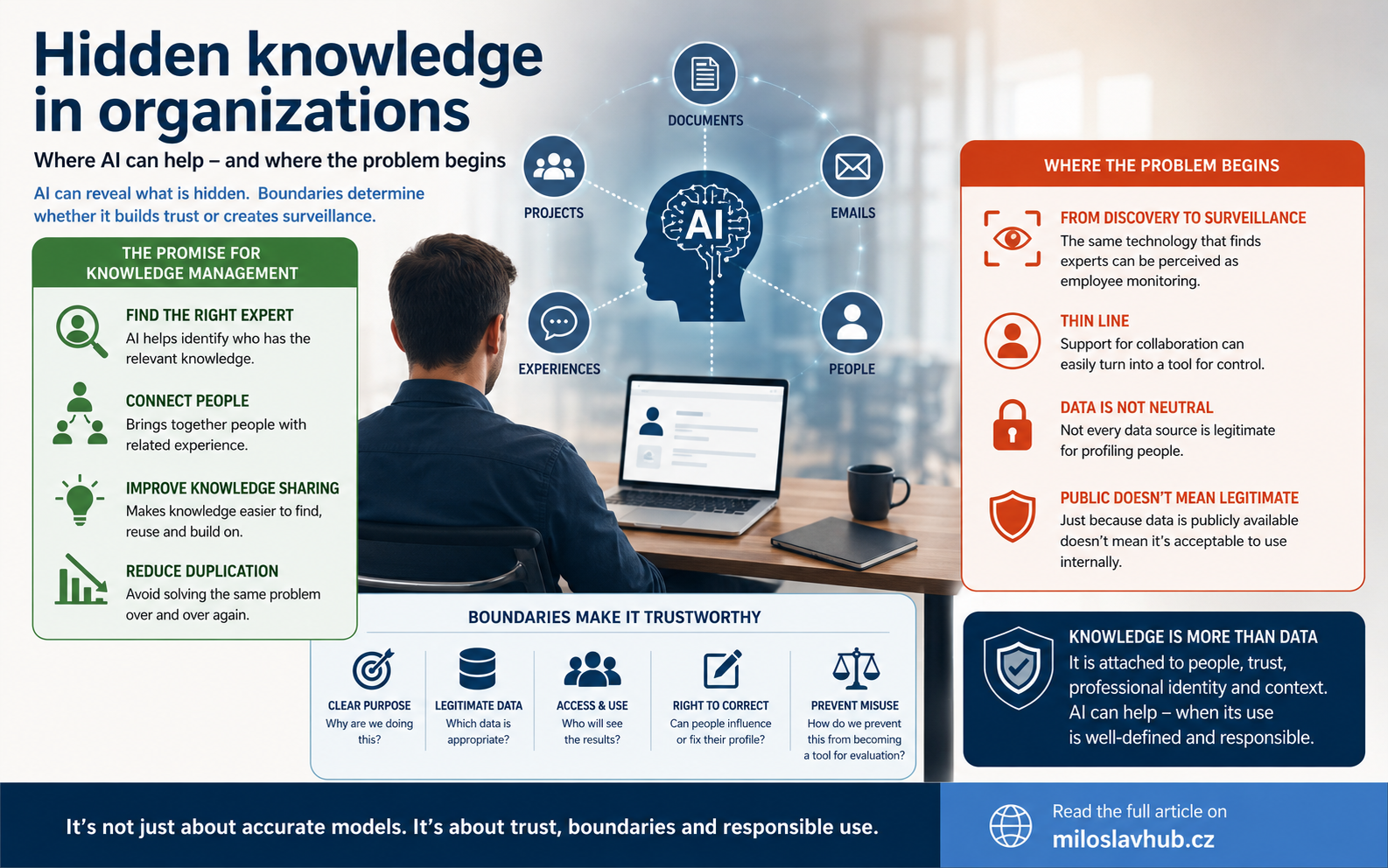
This is where AI can appear particularly attractive. It can search texts, identify patterns, connect related topics and suggest who within an organisation may understand a particular problem.
It can help to:
- identify a suitable expert,
- connect people with related experience,
- improve knowledge sharing,
- reduce the repeated development of solutions that already exist.
From a knowledge-management perspective, this is a powerful promise. Organisations may be able to make better use of experience they already possess but cannot currently find when it is needed.
When knowledge discovery becomes employee profiling
At the same time, a sensitive problem arises. A system designed to discover knowledge may also be perceived as a system that profiles employees.
The same technology may help identify an expert for a particular problem in one context, while in another creating the impression that the organisation is monitoring what people write, whom they communicate with and which abilities an algorithm attributes to them.
Bounded knowledge visibility
Our research therefore works with the concept of bounded knowledge visibility. The underlying idea is simple: the technical ability to analyse something does not automatically make doing so organisationally legitimate.
The acceptability of an AI tool depends particularly on whether the analysis is:
- useful for a specific work-related purpose,
- relevant to the person’s work,
- transparent,
- based on data used for a legitimate purpose,
- accompanied by an opportunity to influence or correct how the system interprets a person’s knowledge.
Publicly available does not automatically mean legitimate
Respondents in our survey generally considered hidden knowledge valuable and expressed a willingness to share it. At the same time, however, they drew clear distinctions between different types of data.
The analysis of work-related content was more acceptable than the analysis of public profiles. This is an important finding: the fact that information is publicly available does not automatically mean that an employer can use it without concern for internal algorithmic profiling.
Organisations should not begin with the technology
Companies and institutions seeking to use AI to discover knowledge and expertise should not begin by selecting a tool. They should begin by defining the rules.
- What specific problem are we trying to solve?
- Which data are legitimate for this purpose?
- Who will be able to see the results of the analysis?
- Will an inaccurate profile be open to correction?
- How will we prevent support for collaboration from becoming a tool for evaluating people?
Only after these questions have been answered does it make sense to decide on a technical solution.
Knowledge is more than data
AI can be highly useful in knowledge management. It can make visible what remains hidden in projects, documents and accumulated experience. For precisely this reason, however, its use must be carefully bounded.
Knowledge is more than data. It is connected to people, trust, professional identity and the context in which it was created.
Practical conclusion
Model accuracy is not enough. Boundaries matter.
The future of AI in organisations will not depend solely on model accuracy. It will also depend on whether organisations can establish trustworthy rules defining what AI may make visible and where clear boundaries must remain.